It's said that back in the 17th century, an Alsatian monk boiled some fermented cherries in the hopes of producing an elixer to cure cholera. He named it "eau de vie" or"water of life." It may be a tall tale, but for several hundred years, the Alsace region has been producing unsweetened fruit brandies called eaux de vie. (Not to be confused with liqueurs.) This legacy continues in France, Switzerland and Germany and, more recently, on America's West Coast. Eaux de vie are arguably one of the world's finest digestifs and are silky, with a heady aroma, a taste of fruit and they pack a powerful wallop; it's almost like biting into a ripe fruit.
My daughter Tracy was home for a few days last week and we got into a discussion about eaux de vie (pronounced oh duh vee) and how much she enjoyed it when she lived in Paris. This is not going to be news to you European bloggers because it is commonly on your wine menus and many of you probably have a bottle or two at home. We are not so fortunate. Tracy has asked for it frequently in New York City restaurants but few include it on their wine list. Because I knew very little about it, she suggested I blog about it.
And so we did some investigating while she was visiting here. Five wine stores later we found one lonely bottle. And it was French, rather expensive and a poire (pear) eaux de vie. In a couple other places we got blank looks, but in most we were told there was no demand for it so there was no reason to stock it. My daughter said she can find it in her favorite wine shop in NYC- Chambers St. Wines so it's available at your better wine merchants, especially for you lucky people on both coasts. Another helpful manager suggested we try www.winesearchers.com to see who carries it in Florida. Guess what? Hardly anybody. It may be offered more frequently in restuarants on the west coast because there are some distilleries in Oregon and California that produce it. And there are some mail order opportunities as well. I'll give you their websites later in the post.
But back to my story. In the heart of Alsace, eaux de vie is produced in profusion. The many fruit flavors include: Poire (pear), framboise (raspberry) Mirabelle (yellow plum), fraise des bois) wild strawberry), quetsch (purple plum),prunelle (blackthorn or sloe plum), even sapini (pine buds) and gratte-cul (rose hips). Really, the flavors can be just about anything. There is also a Douglas Fir and a rosemary-infused eaux de vie.
The rules that apply to the production of these white alcohols in France are quite strict: absolutely no sugar but there is no requirement that the raw material be locally grown. So the raspberries may come from Romania and the mirabelles from Lorraine, where summers are cooler and plums ripen slower resulting in more flavor. The quality of the fruit is what makes a premium eaux de vie. The fruit has to be free from bruises or cuts. So it's of prime importance to have fine fruit to start with.
It takes 8 hours of continuous distillation to turn fermented fruit into eaux de vie. The fruits are mashed and fermented and then distilled twice in traditional copper pot stills that render a clear, intense spirit.
After distillation, the new eaux-de-vie rest a few months to become mellower, smoother and rounder, while developing a complex, many-faceted character, but really without anymore aging than that.
It takes about 20 pounds of mirabelles, 18 pounds of wild raspberries and 30 pounds of pears to make one bottle of eau-de-vie. Connoisseurs, and of course Alsatians, argue that their fruit alcohols are superior to those made in Switzerland and Germany. Those countries, they say, allow artificial fruit essences to be added. Eaux de vie are strong, hovering around 45 percent alcohol. They are very pure, the Alsatians say, because they have none of the chemical or color additives normally added to Cognac, Armagnac and Calvados.
Another way to describe eaux de vie is to say they are the anti-vodka. The point of vodka distillation is to remove all the flavors; the point of eaux de vie is to preserve as much of the original fruit as possible. Because it is a digestif, it is usually served after dinner. But in Alsace, the locals often sip them with cheese, or with one of their tarts. They should be served cold but never over ice. And serve them in chilled glasses. What's important is that the glass and the eaux de vie be the same temperature so as not to shock them.
There is also something called a poire prisonniere. Unlike other eaux-de-vie, poire prisonniere captures the fruit itself. Early in the growing season, when the pears are just forming on the trees, glass bottles are tied over some of the most promising buds. The pear grows inside the bottle, and when it is ripe, it is cut from the tree-still in the bottle. Both bottle and pear are washed and pear brandy is added. The whole pear is in the bottle you buy, its beauty and flavor completely intact. Some French firms say this doesn't change the flavor one bit and one says: "C'est un gadget". (It's a gimmick)

My daughter, son and I had a tasting of our purchase the other night. We had been advised to use either small brandy snifters or some small tulip shaped glasses, which I have. The initial sniff was of fresh pears. The first sip takes your breath away. (This is strong stuff!) And the aftertaste is pear. It was delicious! But be careful, remember this is a digestif, not something you gulp down and ask for another.
In the meantime, satisfy your craving for fresh fruit and find some "water of life". Who knows? It may stave off a cold!
Did you think I was going to leave you without a recipe today? Nay, nay. And it's a dandy too.
Eaux de Vie Pear Compote with Eaux de Vie Pear Sorbet
From Pastry Chef Alba Estenoz, ZINC Modern American Food
Ingredients for compote:
6 Bartlett or Anjou Pears
Juice of 1 lemon
2 Tablespoons Poire Eaux-de-Vie
½ cup Sugar
2 Tablespoons Butter
¼ teaspoon salt
Method for compote:
Peel pears and cut into small dice. Toss with lemon juice. Caramelize sugar in pan over medium heat. First the sugar will melt, then crystallize, then begin to melt again and turn golden brown. When it is completely melted, add the butter and salt. Then add pears and you will find the caramelized sugar will seize but that's OK. Stir a bit and then add Eau de Vie and continue to cook until pears are slightly translucent and much of the fluid has dissolved. Remove from heat, cool, serve at room temperature or refrigerate until you are ready to use.
Ingredients for Pear Sorbet:
1 ½ cup water
1 ½ cup sugar
2 Tablespoons light corn syrup
4 ½ cups ripe pears, diced and peeled
½ teaspoon salt
2 Tablespoons Poire Eaux de Vie
Method for Pear Sorbet:
Combine water, sugar, syrup and salt in large saucepan. Bring to boil; add pears and simmer until pieces are very tender. This took about 45 minutes. Let the mixture cool slightly; puree in blender or food processor; use caution when blending hot mixtures in blender or food processor.
Cool puree for at least 3 hours; freeze.
Serve frozen sorbet with pear compote; compote should be served at room temperature.
Here is Food and Wine's list of the best eaux de vie producers, plus some additions from other sources. You can check out these websites and find out where you can buy locally or order online.
Clear Creek Distillery
Steve McCarthy founded this Portland, Oregon–based distillery in 1986, when he decided to experiment with his family’s pear crop. He now produces seven kinds of eaux-de-vie from local fruit, including blue and Mirabelle plums. clearcreekdistillery.com. (Top Picks: Kirsch (cherry), Blue Plum, and Douglas Fir
Peak Spirits
This new western-Colorado producer buys only organic fruit grown within 20 miles of the distillery, including pears, cherries and the Rosa and Cresthaven peaches it uses for its summery peach eau-de-vie. peakspirits.com.
Purkhart
This Austrian distillery makes the deeply flavored Pear Williams eau-de-vie and the excellent Blume Marillen (“Blossom of the Apricot”), a floral, apricot-based brandy with fruit from the Danube Valley. alpenz.com.
Reisetbauer
Many think fastidious Austrian distiller Hans Reisetbauer makes the world’s best eau-de-vie (at up to $170 a bottle, it’s priced accordingly). Reisetbauer’s enormous portfolio includes classic eaux-de-vie varieties and bottles featuring unlikely flavors like carrot, ginger and the piquant rowanberry. reisetbauer.at. (Top picks: Pear, Plum, and Rowanberry (complex, with fruit and marzipan notes); also Ginger and Carrot (both are fascinating, if not typical flavors for an after-dinner drink)
St. George Spirits
Alsace native Jörg Rupf, who founded this Alameda, California, distillery in 1983, has helped spread the eau-de-vie gospel to many other microdistillers. In addition to crafting cherry, pear and raspberry eaux-de-vie, St. George offers experimental brandies, including one derived from Thai basil. stgeorgespirits.com
Meyer
Alsace, France; Top picks: Kirsch (cherry, with a delicious touch from the cherry stones) and Quetsch (dark red plum
Etter
Switzerland
Top picks: Fruit Tree Blend, Zuger Kirsch Three Year Old (cherry)
Westford Hill
This 10-year-old Connecticut-based distillery bottles four kinds of premium eaux-de-vie, including the fragrant Pear Williams, made from ripe Bartlett pears. westfordhill.com.
The two most well known firms on the west coast are St. George Spirits (http://www.stgeorgespirits.com/) and Clear Creek Distillery. (http://clearcreekdistillery.com/index.php) Both of these sites will list stores where their wines are available to those of us who can't find them locally.
Photo credits for this post:
http://www.cocktailia.com/articles/clear-creek-distillery
http://www.eaux-de-vie.com/
Source information for this post:
http://www.nytimes.com/1998/04/01/dining/eau-de-vie-fruit-s-essence-captured-in-a-bottle.html?pagewanted=1
http://www.sallybernstein.com/beverages/spirits/eau_de_vie.htm
http://findarticles.com/p/articles/mi_m1365/is_n9_v23/ai_13869737/http://www.cocktailia.com/articles/clear-creek-distillery
http://www.cocktailia.com/articles/clear-creek-distillery
http://www.nytimes.com/1984/08/26/travel/alsace-s-eaux-de-vie-pack-a-fruity-punch.html
http://www.eaux-de-vie.com/
My mother had a dear friend named Alice Moore. Alice and her husband lived in a town nearby and spent many summer vacations with us cruising Georgian Bay and environs on dad's boat. It also happens that Alice was an exceptional cook, which of course was how the friendship got started because so was my mother. They babbled on and on about recipes and entertaining and as a result of their long friendship, I have inherited quite a number of Alice's recipes.
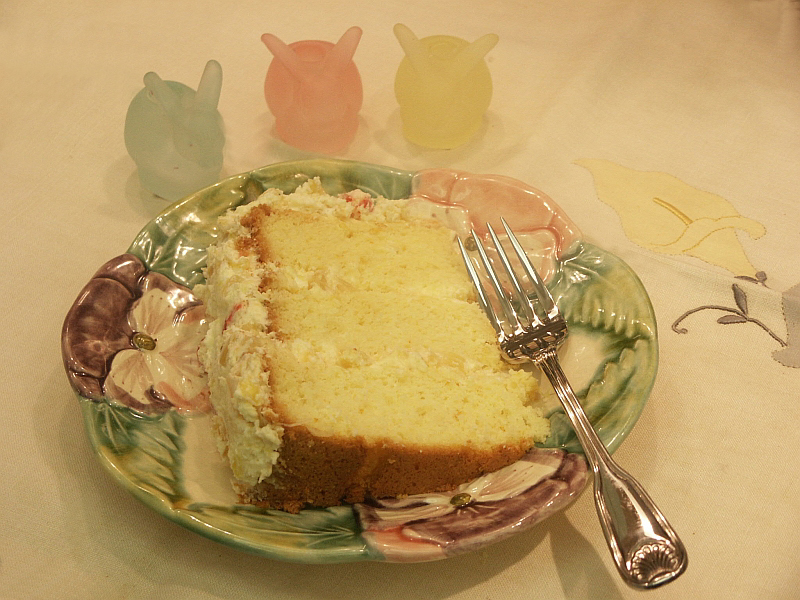
One of Alice's tastiest desserts was a family favorite and we served it often at Easter because not only does it serve a lot of people but it brings a much needed breath of spring to a gathering. It needs to be refrigerated so it's also a cool, refreshing dessert on a hot summer's day. It used to be simpler to make because years ago the A & P carried a ready-made yet excellent quality orange sunshine cake. Not anymore so you have to make the cake yourself. It's a basic orange sponge cake and really quite easy. The cake is divided into three layers and spread with a lovely mixture of fruit and whipped cream. I decorated it with some of those cute William Sonoma Easter cookies. (Luckily we didn't eat them all before I got them on the cake!)
Alice's Party Cake

Ingredients:1 orange chiffon cake (recipe follows)
1 #2 size can crushed pineapple, drained well
1 packaged instant vanilla pudding
1/3 cup marachino cherries, cut up
2-1/2 cups whipping cream
Method:Cut the cake into three even layers. Whip the cream, add the pudding, cherries and pineapple. Layer with this mixture and frost the entire cake. Refrigerate.
Orange Sunshine Cake
Ingredients:6 large eggs, separated plus 1 additional egg white
2 -1/4 cups sifted cake flour
1- 1/2 cups superfine white sugar
1 tablespoon baking powder
1/2 teaspoon salt
1/2 cup vegetable oil or safflower oil
3/4 cup freshly squeezed orange juice (2 - 3 large Navel Oranges)
2 tablespoons orange zest
1 teaspoon pure vanilla extract
3/4 teaspoon cream of tartar
Method:Separate the eggs and place the whites in one bowl and the yolks in another. Cover with plastic wrap and bring them to room temperature (about 30 minutes).
Preheat the oven to 325 degrees and have ready a 10 inch two piece tube pan (ungreased).
In the bowl of your electric mixer, fitted with the paddle attachment, place the flour, sugar (minus 3 tablespoons , baking powder, and salt. Beat until combined. Make a well in the center of the flour mixture and add the egg yolks, oil, orange juice, orange zest, and vanilla extract. Beat about one minute or until smooth. In a separate bowl, with the whisk attachment, beat the egg whites until foamy. Add the cream of tartar and continue to beat until soft peaks form. Gradually beat in the remaining 3 tablespoons of sugar and beat until stiff peaks form. With a large rubber spatula or wire whisk, gently fold the egg whites into the batter just until blended (being careful not to deflate the batter).
Pour the batter into the ungreased tube pan and bake for about 55 to 60 minutes, or until a wooden skewer inserted into the center of the cake comes out clean. (When lightly pressed the cake will spring back). Immediately upon removing the cake from the oven invert the pan and place on a bottle or flat surface so it is suspended over the counter. Let the cake cool completely before removing from pan (about 1-1/2 to 2 hours).
To remove the cake from the pan, run a long metal spatula around the inside of the tube pan and center core. Invert onto a greased wire rack.
You can store this cake (unfrosted of course) in an airtight container for a few days at room temperature or for about a week in the refrigerator. This cake (unfrosted) can also be frozen for a couple of months.
We've always had ham for Easter. This is not necessarily a favorite with the women in the family so once in a blue moon I sneak in a leg of lamb, which I've always considered the only acceptable alternative to ham on Easter Sunday. But the guys always want ham. And in the same breath they ask: are you making the mustard ring? Which, as near as I can figure, is a necessity or don't bother having ham. It's tricky to get anyone outside the family to try this recipe. I even posted it when I first started blogging but sincerely doubt anyone made it. You probably thought I was nuts.
Back in the 60's this mustard ring won best of show in a big, albeit local, cooking competition. My friend Grace was the winner and she told me it was an old family recipe. Only I never got the chance to taste it that day and when all the recipes were finally published in a cookbook, I just stared at it dubiously, wondering how on earth it ever won over all the fierce competition. So this mustard ring had to be beyond great, right? It even beat out some scrumptious desserts! Well, well. Best in Show. Good for you, Grace!
But it still took me a couple years before I finally made it. It's not rocket science but it does take a little time. The color is such a delicate yellow, making it very Easter-like. I spoon-tasted it as it was cooling and it was sweet with a tangy bite; pretty tasty actually. Then you fold in some cold whipped cream and the color turns an even softer yellow and while the bite is still there, it's not as sweet. And served with ham? Spectacular. Unusual. The first question invariably is: what is this?? Some kind of lemon dessert? Definitely not. In the end, everyone is asking if it will keep in the fridge for leftovers. And they've been asking for it ever since.
You don't need to make it in a ring mold (although it puts to good use the old molds we used to make those ghastly jello salads in) but I do because it's fun to fill the center with something. If I have it at Christmas, I use holly. Other times I've used black olives, crabapples, flowers, fruit...just about anything. But my favorite is a Rhubarb (quelle surprise) Ginger Compote. I love the colors together. And spring is always when I first get my hands on some rhubarb.
Here's a prediction: you're going to read this post, comment politely that it looks good and then not try it. I know, because that's what I did. But just this once, when ham is next on your menu, please remember Grace's prize-winning Mustard Ring. You have to make it a day ahead anyway (I've made it as much as 3 days ahead) so you're not adding one more thing to think about for dinner that day.
And because I'm mad for the Rhubarb-Ginger Compote, I'm posting that recipe too. Don't wait for the mustard ring to make the compote, because it's a killer recipe. I keep sneaking spoonfuls!
Grace's Mustard Ring

Ingredients:
4 eggs
3/4 cup sugar
2 tablespoons dry mustard ( I use Colman's)
1 envelope gelatin
1/3 cup water
2/3 cup vinegar
1/4 teaspoon salt
1 cup whipping cream
Method:
Whisk the sugar and dry mustard together in the top of a double boiler to make certain there are no lumps. Add the vinegar and water and then the well beaten eggs.
Soak the gelatin in 1 T. cold water then melt over hot water.
Cook the egg/mustard mixture slowly in double boiler stirring constantly, adding gelatin when it becomes hot. Cook until creamy and thickened. Remove from heat, cool over ice cubes.
When cool, beat the whipping cream until peaks form. Slowly fold in the cooled mustard mixture. Pour into a mold and chill.
Rhubarb-Ginger Compote
From an article entitled Rhubarb Bites by Molly O'Neill, New York Times Magazine, May 15th, 1994
Ingredients:
2 teaspoons olive oil
2 shallots, peeled and minced
2 cloves garlic, peeled and minced
2 tablespoons grated ginger
2 cups water
1 cup sugar
4 cups rhubarb, trimmed and cut into 1/4-inch slices
2 tablespoons plus 2 teaspoons rice-wine vinegar
1/8 teaspoon salt
Freshly ground pepper to taste
Method:
Heat the olive oil in a medium-size saucepan over medium heat. Add the shallots and garlic and cook until softened, about 2 minutes. Add the ginger and cook, stirring, for 45 seconds. Add the water and sugar and bring to a boil. Reduce the heat so that the liquid barely simmers. Add the rhubarb and cook without simmering until the rhubarb is tender but still whole, about 12 minutes.
Remove rhubarb from the liquid with a slotted spoon and place in a bowl. Bring liquid to a boil. Cook, adding juices that accumulate from the rhubarb, until reduced to 1 cup, about 30 minutes. Set aside to cool. Stir in vinegar, salt and pepper. Stir in the rhubarb. Serve immediately or store in the refrigerator.
Makes 2-1/2 cups